The temperature looks right. So why are the parts changing? 🤨
In injection molding, a few degrees can make a surprising difference. And the numbers on the machine don't always tell the whole story.
Temperatures are within range, cycle times are consistent, and everything seems to be running smoothly. Yet subtle variations begin appearing in the finished parts.
One possible culprit is melt temperature.
The temperature displayed on the machine isn't necessarily the temperature the polymer actually experiences. Screw speed, shear heating, residence time, and even differences between material batches can influence how the melt behaves.
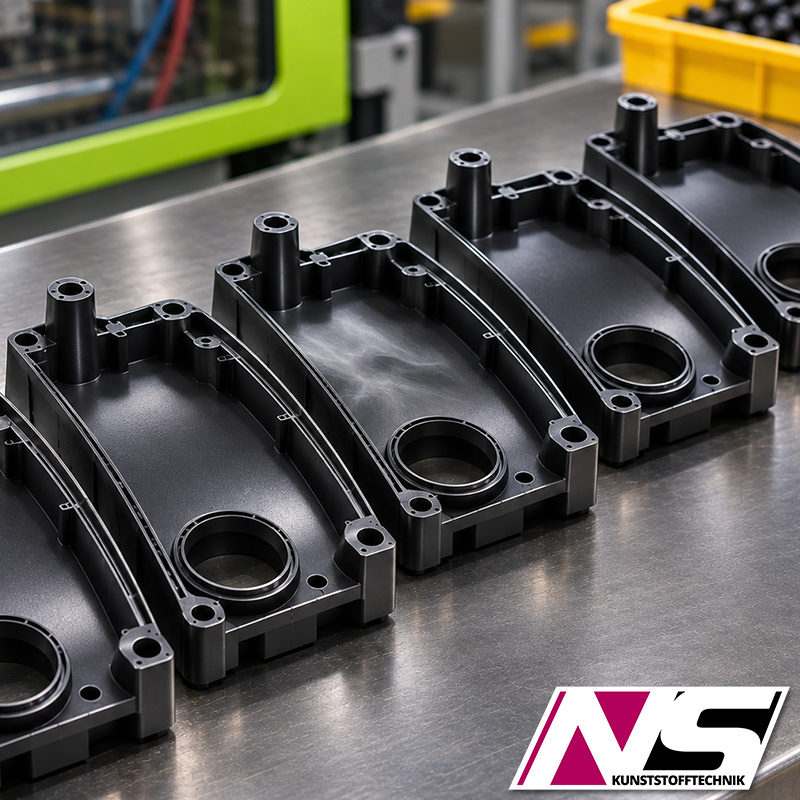
Those variations can affect viscosity, material flow, cavity filling, and ultimately the properties of the finished component. Sometimes the consequences are immediately visible. Other times, they only become apparent during dimensional checks or performance testing.
At NS KUNSTSTOFFTECHNIK - CZ, we've learned that keeping a process stable takes more than holding individual settings within their limits. It means understanding how they interact, recognizing changes in material behaviour, and knowing when apparently normal readings deserve a closer look.
That's where practical experience and continuous monitoring work together. We're not just looking for a good part. We're looking for the conditions that consistently produce good parts.
After all, producing one perfect component is one thing. Producing ten thousand (or million!) of them is another. 🦾