The best engineering concept rarely wins every comparison.
One design may simplify molding but add complexity to assembly. Another may improve performance while demanding tighter tolerances. A third may reduce tooling complexity but increase cycle time or material cost.
This is where the Pugh Matrix becomes especially useful.
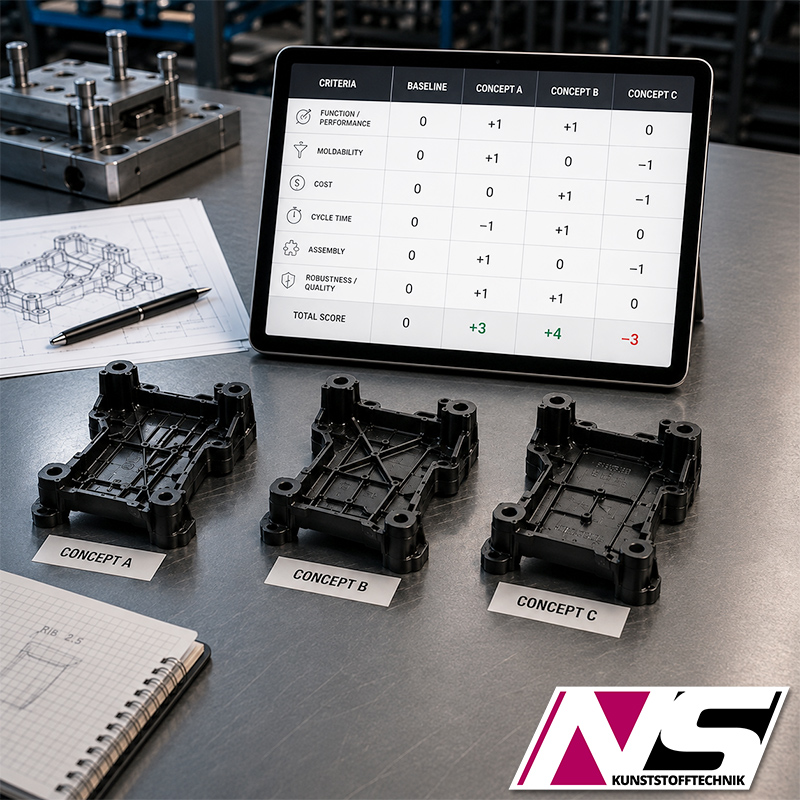
Rather than comparing concepts through instinct or isolated technical discussions, teams evaluate each option against the same critical-to-quality criteria. A baseline concept is established, and alternatives are scored consistently against it.
A higher total gives you a front-runner. The real engineering value comes from understanding where each concept wins, where it loses, and why.
Those patterns can reveal trade-offs that deserve a closer look. They can expose risks before a design is locked. And sometimes they point toward a stronger hybrid concept that combines advantages from multiple options.
For injection molded components, those conversations can cover geometry, material selection, tooling, tolerances, assembly, quality, cycle time and cost.
At NS-K, we use structured methods alongside decades of practical molding experience to help customers evaluate these decisions early.
Because the earlier a trade-off becomes visible, the more freedom engineering teams have to do something about it.