
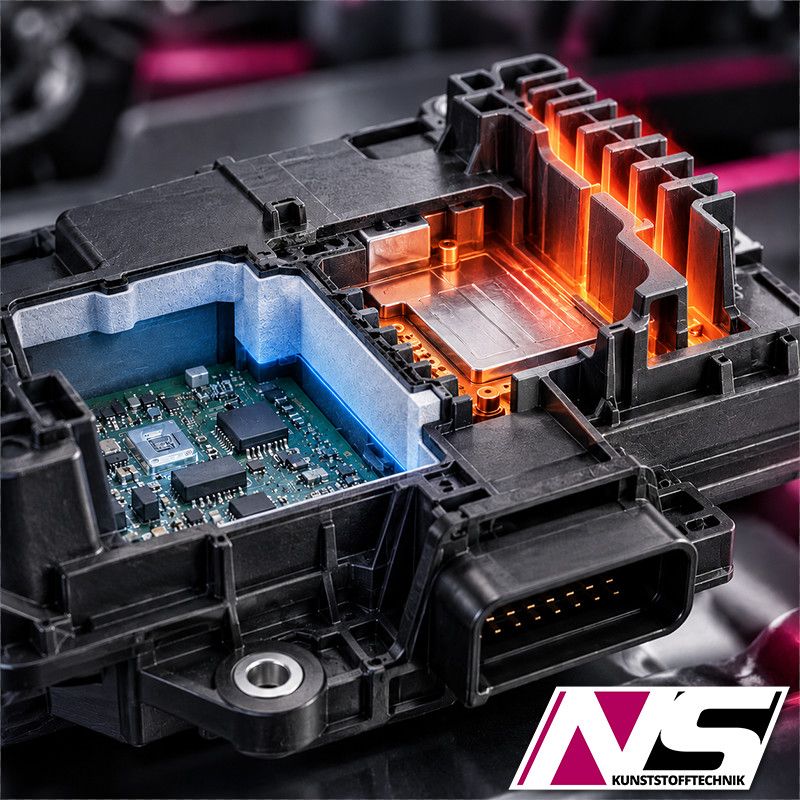
A plastic component can be an excellent thermal insulator and still be completely wrong for the application.
We all know that heat resistance has always mattered in automotive plastics. But as assemblies become more compact and electronics generate more heat, another question is becoming just as important: what should the plastic actually do with that heat?
Consider an electronic housing. One area may need to protect sensitive components from an external heat source, while another needs a reliable path for internally generated heat to escape. A material that insulates exceptionally well in one location could become a problem in the other. And switching to a thermally conductive compound doesn't automatically solve the whole design.
Higher conductivity can come with compromises in cost, mechanical behavior, electrical properties, and moldability. Even the way a filled polymer flows through the tool can influence how effectively heat travels through the finished part.
That's where the discussion becomes more interesting than simply comparing material data sheets. 🤓
At NS KUNSTSTOFFTECHNIK - CZ, we see this as a useful reminder to consider the complete assembly early in the design process. Material choice, wall thickness, geometry, interfaces, and processing conditions all influence the outcome. A seemingly minor housing or support can affect the thermal behavior of components around it.
The most interesting engineering challenge may be that improving a material's thermal performance doesn't always improve the assembly. Sometimes, the better solution is to transfer less heat, redirect it, or keep it away from somewhere it doesn't belong.

