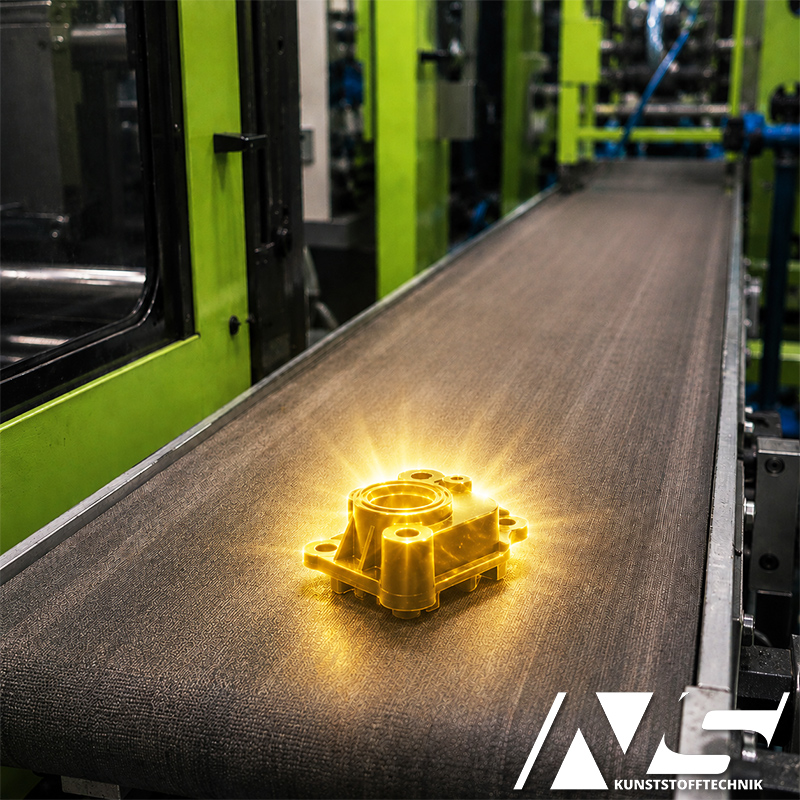
One molded part on a conveyor belt might not look like much, but it could represent months of development, testing, and the first step toward full-scale production.
We all know about the massive number of automotive parts produced every day. But what happens when a project only needs a smaller production run? Does injection molding still make sense?
Absolutely.
Low-volume injection molding, typically defined as production runs of 20,000 parts or fewer, plays a critical role in modern manufacturing. It allows companies to validate designs, test functionality, support niche programs, and bridge production gaps without immediately committing to full-scale tooling investment.
One of the biggest advantages comes from tooling flexibility. While high-volume programs usually rely on hardened steel molds designed for millions of cycles, low-volume projects can often use aluminum tooling instead. These molds are faster to produce, easier to modify, and significantly more cost-effective during development and early-stage production.
That flexibility is especially valuable when speed matters. Manufacturers can evaluate real molded parts under actual production conditions before committing to long-term mass production strategies. It reduces risk, accelerates development timelines, and creates room for refinement before scaling up.
Of course, every project has different long-term requirements. The key is choosing the right approach at the right stage of the project.
At NS KUNSTSTOFFTECHNIK - CZ we support everything from small prototype and short-run programs to multi-million-unit production orders. Our team helps customers identify the most effective manufacturing path for their specific goals, timelines, and budget.
Because sometimes, even a single molded part can represent the beginning of something much bigger! 🦾