MSA helps us answer a simple but critical question: “Can we trust the data we’re using to make decisions?”
Measurement System Analysis (MSA) is the foundation of trustworthy data, and here at NS-K we use it to prove our measurement systems are reliable so that every decision about plastic part quality is based on fact, not guesswork.
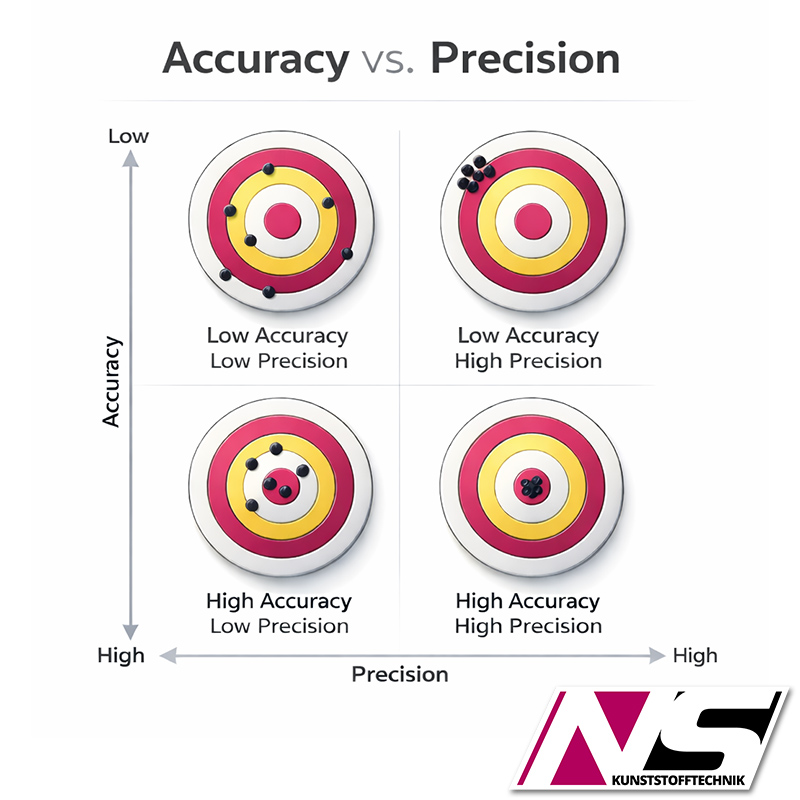
This structured set of studies helps us evaluate the accuracy, precision, stability, and repeatability of the tools and methods we use to inspect parts. If the measurement system is noisy, you can't tell whether variation comes from the part or the gauge, and that uncertainty quickly undermines improvement efforts. 🤦♂️
In practice, we treat MSA as a routine, documented activity, not a one-off audit. With that in mind, there are key steps we run for every critical characteristic:
✔️ Gauge R&R (Repeatability and Reproducibility) studies under real production conditions to quantify measurement variation.
✔️ Bias and linearity checks to ensure instruments read correctly across the full measurement range.
✔️ Stability studies to confirm instruments remain reliable over time and under changing environmental conditions.
Injection molded components often have tight tolerances, complex geometries, and material behaviors such as shrinkage and creep that vary with temperature and processing. Reliable measurement systems help reduce false rework, avoid unnecessary tooling changes, and speed up approvals.
Simply put, accurate data means fewer corrective actions and clear, traceable evidence that parts meet specification every time. That leads to better outcomes for us and for our customers. 🦾
At NS KUNSTSTOFFTECHNIK - CZ-K we embed MSA into project timelines, training, and supplier audits so measurement integrity is never an afterthought. If you value predictable quality and data you can trust, that's the difference we bring to your program: Quality with integrity.